


👌 In today’s post, we’ll explore
The Big Bang: How the “Startup Law” changed the game for everyone.
The Residency Trap: Understanding the (crucial) difference between legal and tax residency.
Your 2026 Checklist: Everything you need to secure your Digital Nomad Visa.
The 24% Club: Deciphering the specific criteria for the Beckham Law.
At a Glance: A comparative table to clear up the confusion once and for all.
Beyond the Paperwork: Why aligning your strategy and mindset is the ultimate key to success.
✈️The Startup Law: A Game Changer
In 2022, the Spanish Government approved the “Startup Law,” a landmark regulation that impacted several different areas of legislation at once. Its goal was simple: to turn Spain into a magnet for international talent and investment. The law introduced three major shifts:
Corporate Tax Law: It finally defined what a “startup” is, creating measures to kickstart growth and ensure that knowledge circulates within the ecosystem rather than gathering dust.
Immigration Law: It regulated the Digital Nomad Visa (DNV), rolling out the red carpet for remote workers and entrepreneurs from all sectors to set up shop in Spain.
The Beckham Law (Personal Income Tax): It upgraded the special tax regime for displaced workers, making the 24% flat tax more accessible to a wider range of professionals.
🧠Legal Residency vs. Tax Residency
Why is there so much confusion between the Digital Nomad Visa and the Beckham Law? It’s because they address two entirely different things:
The Digital Nomad Visa is about Legal Residency. It is your permission to live and work in Spain for a specific period (usually up to 3 years initially). Without it, you are generally limited to a 90-day tourist stay.
The Beckham Law is about Tax Residency. It is a special tax regime that determines how you are taxed.
Someone can have legal residency in several countries, but you will always end up paying taxes according to the rules of your country of tax residence. Having the visa (the right to be here) does not automatically mean you meet the criteria for the tax benefit (the right to pay less).
🗒️Criteria for the Digital Nomad Visa (2026 Checklist)
To ensure your move to Spain flows without any administrative blockages, here is your essential checklist:
Professional Standing: You’ll need a university degree or, failing that, at least 3 years of proven experience in your field.
Company Longevity: Your employer (or your own company) must have been active for at least one year. You must have been working with them for at least 3 months.
The 80/20 Rule: If you are a freelancer, your income from Spanish clients cannot exceed 20% of your total turnover.
Financial Requirements (2026 SMI): For the main applicant, you must demonstrate approx. €2,849/month. Add €916 for a partner and €305 for each additional family member.
Health & Safety: You need a comprehensive private health insurance policy (no co-payments) and a clean criminal record from the last 2 years.
📔The 24% Club: Who qualifies for the Beckham Law?
The Beckham Law allows you to pay a flat 24% tax rate, but the requirements are strict:
The 5-Year Rule: You cannot have been a tax resident in Spain during the last 5 years.
The Trigger for the Move: You must move to Spain for one of these specific professional reasons:
The Remote Employee: You are hired by a Spanish company or relocated by your foreign employer (requiring a formal authorization letter and Social Security coverage).
The Company Director: You move to manage a company. If it is an asset-holding company, your ownership stake must be limited to avoid “linked entity” status.
The Entrepreneur: You are starting a business labeled as “innovative” by ENISA.
The Highly Qualified Professional (HQP): You provide services to startups or engage in R&D activities (representing over 40% of your income). Note: To meet this specific Beckham Law criteria, you usually need a “Highly Qualified Professional” visa rather than a standard Digital Nomad one.
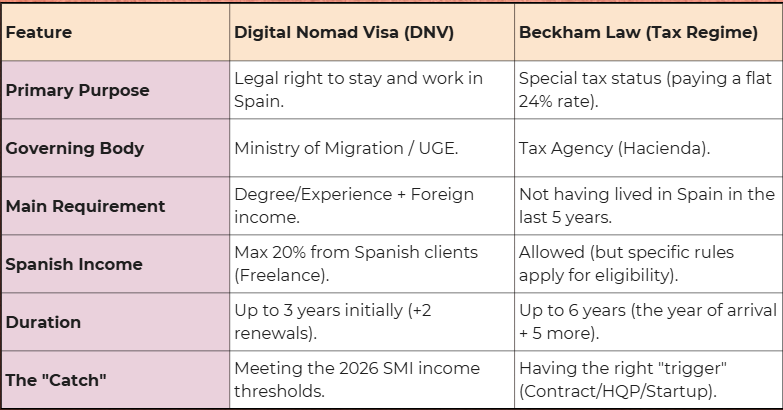
💊Comparative chart of the 2026 eligibility criteria for the Spanish Digital Nomad Visa versus the Beckham Law special tax regime
🐚Conclusions
As you can see, the Beckham Law only includes one very specific scenario for freelancers and according to the law, they should be in possess of an ENISA report (meaning, developing an innovative activity in Spain). Most other scenarios apply to different types of visas. Understanding the difference between your legal right to stay and your fiscal obligations is the first step toward a successful, stress-free life in Spain.
🌟Mindset: Aligning your Fiscal and Personal Energy
At the end of the day, understanding the difference between a Visa and the Beckham Law is about more than just numbers—it’s about alignment.
In entrepreneurship, we often talk about “flow,” but it’s hard to stay in a creative flow when you are worried about administrative blockages or unexpected tax hits. Clearing the path legally and fiscally is a form of self-care. It’s about creating a “safe container” for your project to grow.