


In general, when we go to school, there is a kind of classification—spoken or unspoken—of the “nerds,” the good ones, the mediocre ones, and those who need extra help. This has its origin in an educational system that was forged during the Industrial Revolution and, even now, almost a hundred years later, we still haven’t changed the operating framework.
Back then, it wasn’t necessary to educate; it was necessary to establish basic knowledge so that children could be future producers.
That is to say: that they would choose a job (very likely on an assembly line or repetitive) and dedicate their whole lives to it. With automation, social evolution, and now the emergence of AI, we find ourselves facing an obsolete educational model that only adds pressure to teachers and sets aside the needs of this convulsed world in which we live.
🫥The gap between the system and our unique brilliance
Taking all this into account, I want to talk to you about what I consider has been missing in the educational system and what has made us believe we are not valid or complete enough: the different types of intelligence. In 1983, Howard Gardner questioned the traditional notion of intelligence. He maintained that the human being does not have a single capacity, but multiple intelligences. Specifically, he specified seven and stated that all were relevant and independent of each other:
Musical: For those who find the melody in the noise of an office. You have a radar for rhythm and tone.
Bodily-kinesthetic: Mastery of the body. From surgeons to dancers; if you are skillful with your hands, you have it.
Visual-spatial: The ability to mentalize the world in 3D. Typical of those who park on the first try or the entrepreneur who “sees” the product before it exists.
Verbal-linguistic: The art of the word, of convincing and telling stories that captivate.
Logical-mathematical: The kingdom of patterns and logic where others only see a chaos of data.
Intrapersonal: The superpower of self-knowledge. Knowing what you feel and how to manage it so as not to collapse.
Interpersonal: The social antenna. Capturing the emotions of others to truly connect with them.
Later, in 1990, Salovey and Mayer coined the term “emotional intelligence,” which Daniel Goleman popularized throughout the business world.
⛓️💥Breaking free from the labels that hold us back
I am telling you this because, when I became aware that you are not simply “smart or dumb,” “successful or a failure” according to the terms of formal education, you can free yourself from many stigmas. I love remembering that image where a teacher makes all the animals take the same exam: to be “fair,” they all have to climb a tree. The monkey will nail it, but the fish...?
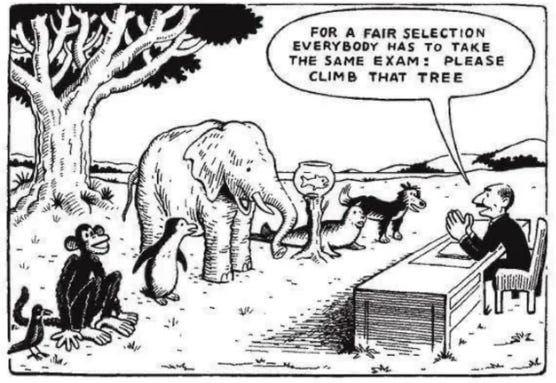
In the case of animals it is obvious, but what happens with humans, who in principle all have the same shape? How do we detect which intelligence predominates in us? How can we fit into a system that tends to unify instead of individualize?
I invite you to reflect on it because, now that AI is the best “nerd” that exists, how will we differentiate ourselves from the machine? 🤖
I would love to know your point of view in this regard 😊
This is where I offer to accompany you to find your strengths, what makes you unique and unrepeatable. My purpose is for you to find what you are naturally good at. If we put each animal in its environment, it has no rival. Imagine the fish: if we put it in the water with the other animals from the exam, the only ones who can compete will be the seal and the penguin. The rest won’t even see it pass.
Message me 🌟